
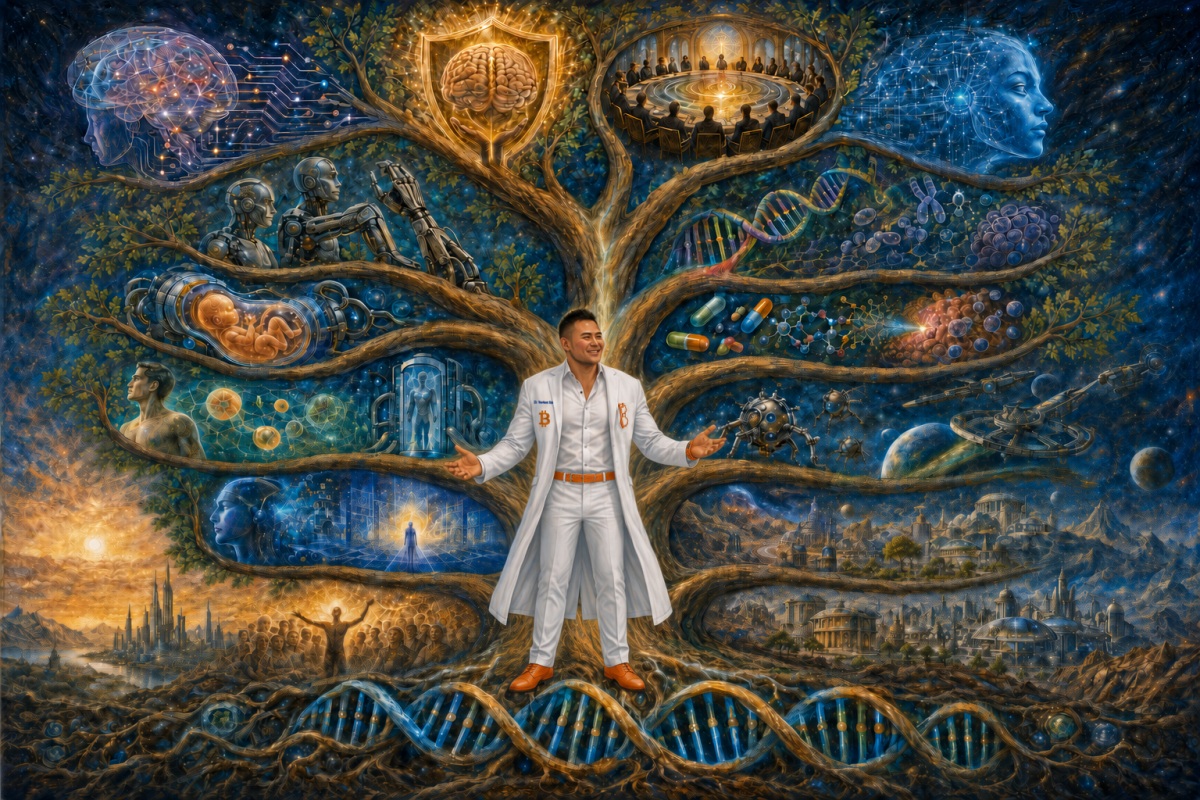
In my illustration above entitled: “The Transhumanist Tree of Life.” (Nov 2025), a colossal tree grows from a glowing human DNA helix. Its 12 major branches represent the complete field of transhumanism. Some branches are biological—genetics, reproduction, medicine and longevity. Others become neural circuitry, AI, robotic structures, nanomachines, virtual worlds and spacecraft. The highest branches form a protected brain and a council chamber.
I stand at the trunk, ensuring that every technological branch grows from human values. The art represents that while humanity may transform its body, mind and future — it is imperative that the human being must remain sovereign.
Technology is changing what human beings can know, become and control. Herbert Sim’s work examines this transformation through philosophy, emerging science and the political question underlying both:
How can humanity transcend its biological limitations without surrendering human sovereignty?
This collection is organized into three areas: philosophical foundations, technologies of human transformation, and the rights and governance needed to keep those technologies under human control.
1. Philosophy, Principles and Standards
The philosophical foundations of Herbert Sim’s approach to technological evolution—together with his examinations of the major schools of transhumanist thought.
Herbert Sim’s Original Frameworks
Human-Sovereignty Transhumanism
April 20, 2014
Herbert Sim’s foundational philosophy that technological advancement must remain subordinate to human agency, consent, dignity and self-determination.
The Genome Covenant Manifesto
December 21, 2021
A proposed moral covenant for governing genetic modification while protecting human dignity, diversity and future generations.
Philosophical Foundations
Transhumanism: Quenching the Thirst to Become Superhuman
September 18, 2009
An introduction to humanity’s ambition to overcome biological limits through science and technology.
Extropianism: The Optimistic Frontier of Transhumanism
March 3, 2010
An examination of the philosophy of perpetual progress, rational optimism, self-transformation and resistance to entropy.
Morphological Freedom: The Right to Shape and Upgrade the Human Body
June 18, 2013
An exploration of the individual’s right to modify the body and mind through genetics, neurotechnology, bionics and other enhancements.
Techno-Progressivism: The Philosophy of Advancing Humanity Through Technology and Justice
January 5, 2015
A study of the position that technological progress must be accompanied by democratic governance, social justice and equitable access.
The Hedonistic Imperative: A Vision for the Future of Sentience
April 20, 2007
An examination of David Pearce’s proposal to use biotechnology to eliminate involuntary suffering from sentient life.
Abolitionism in Transhumanism: Ending Involuntary Suffering
June 6, 2007
An exploration of the ethical case for using advanced technology to overcome pain and biological suffering.
2. Technologies of Human Transformation
The scientific and technological systems that could alter human intelligence, biology, longevity, embodiment and evolutionary development.
Brain–Computer Interfaces and Neurotechnology
After AI Comes BCI: Why the Next Tech Revolution Targets the Human Brain
June 6, 2026
Why brain–computer interfaces may become the next defining technological platform after artificial intelligence.
AI-Neurohybrid Intelligence: Toward Cognitive Symbiosis Between Minds and Machines
January 11, 2026
An exploration of intelligence created through direct cooperation between human cognition and artificial systems.
NeuroChip: Developing a Stronger Brain-Computer Interface for Artificial Intelligence Breakthroughs
May 28, 2016
How neurochips could connect human cognition with increasingly powerful artificial intelligence.
From Medical to Consumer-Facing: The Next Wave of Neuroscience Technology
August 3, 2020
How neurotechnology may move from clinical treatment into everyday communication, entertainment and enhancement.
NeuroChip’s Role in the Neuroprosthetic Revolution
November 11, 2022
The convergence of neural interfaces, artificial limbs and sensory prosthetics.
Artificial Intelligence
One Man’s ChatGPT: An Advancement for Mankind
February 6, 2023
An early assessment of generative AI as an amplifier of human knowledge, creativity and productivity.
The Image That Speaks: Generative AI and the New Age of Synthetic Authority
March 3, 2026
How generative AI can manufacture images, voices and apparently authoritative realities.
Convolution of Desire: When AI Knows Your Every Desire—and Your Deepest Fear
April 6, 2026
What happens when predictive systems become capable of modelling intimate human wants, fears and vulnerabilities.
Humanoid Robotics and Bionics
The Future of Skin for Robots: Toward Indistinguishable Human Clones
March 3, 2025
How synthetic skin and humanoid design could make the distinction between humans and machines increasingly difficult to perceive.
Shape-Shifting Robots: Blurring the Lines Between Science Fiction and Reality
April 3, 2023
The emergence of adaptable machines capable of changing form, function and physical behaviour.
The Race to Build Robots With Realistic Facial Expressions
April 4, 2018
How lifelike expression could transform human trust, attachment and interaction with machines.
Soft Versus Hard Exosuits: The Future of Wearable Robotics
May 5, 2012
A comparison of wearable robotic systems designed to restore or amplify human physical ability.
Genetics and Human Evolution
Evolution by Design: Are Humans Ending Natural Selection?
March 14, 2014
Whether genetic engineering will replace natural selection with conscious, technologically directed human evolution.
The Rise of Animal–Human Hybrids: Inside the Labs Blurring the Line Between Species
April 4, 2025
The scientific possibilities and ethical boundaries surrounding chimeras and cross-species biological engineering.
Artificial Wombs: Powering Genetic Breakthroughs and Gender Equality
November 15, 2021
How ectogenesis could transform reproduction, parenthood, genetic research and social equality.
The Chinese Scientist Who Raised a Storm: Villain or Misunderstood Hero?
March 6, 2023
A reconsideration of He Jiankui and the controversy surrounding the first gene-edited children.
Longevity, Cryonics and Digital Continuity
Cryosleep, Cryonics: The Ultimate Path to Immortality?
January 7, 2010
Whether cryonic preservation could allow individuals to reach a future capable of restoring life.
From Flesh to Code: The Pursuit of Digital Immortality
June 6, 2020
The possibility of preserving identity, memory or personality beyond the biological body.
The Fable of the Dragon-Tyrant
June 6, 2006
A philosophical examination of aging and whether accepting death from old age is morally defensible.
3. Human Rights, Ethics and Governance
Technological enhancement does not merely create new abilities. It redistributes power. These writings examine consent, privacy, inequality, accountability and the right to remain unenhanced.
Cognitive Liberty and Neural Privacy
Neural Sharing and the Death of Privacy
June 6, 2025
The threat to privacy when thoughts, memories and emotions can be transmitted, stored or monitored.
If Consciousness Is Programmable, Who Gets to Write the Code?
August 11, 2017
Who should control the systems capable of influencing perception, behaviour and conscious experience?
Mapping the Human Mind: Will the BRAIN Initiative Lead to Freedom — or Mind Control?
October 21, 2013
The tension between the medical benefits of mapping the brain and its potential use as an instrument of surveillance or control.
Equality, Consent and Accountability
The Post-Human Economy: Who Owns Upgraded Intelligence?
May 5, 2026
Whether enhanced cognition will belong to the individual—or to the corporation providing the hardware, software and subscription.
Upgraded Brains, Unequal Futures
December 12, 2014
How unequal access to cognitive enhancement could produce a permanent division between enhanced and unenhanced humanity.
Moral Responsibility With Augmented Brains
June 6, 2014
Who is responsible when human decisions are influenced by implanted, networked or artificially intelligent systems?
When “Fixing” the Human Body Becomes Mandatory
January 2, 2014
How voluntary therapy can become coercive enhancement when employers, insurers or governments redefine what counts as a normal body.
The Ethics of Radical Life Extension
March 3, 2012
The social, economic and moral consequences of making dramatically longer lives possible—but not necessarily equally accessible.
Governance and Militarization
Bostrom’s Big New AGI Idea—But Who Holds the Kill Switch?
December 2, 2025
A critical examination of global AGI governance, ownership and the concentration of control.
Military Transhumanism: Super-Soldiers and Ethical Red Lines
January 3, 2013
The ethical limits of enhancing soldiers through pharmaceuticals, genetics, neural interfaces and robotics.
The Post-Human Military: When One Soldier Commands Fifty Machines
August 5, 2026
How brain–computer interfaces and autonomous systems could transform individual soldiers into commanders of machine swarms.